The Soft Life Compass: Plan Around What Truly Matters


How Do I Know What Truly Matters in Life?
Many people feel overwhelmed because their schedules become filled with other people’s priorities, expectations, and urgent demands. A Soft Life Compass helps you reconnect with what genuinely matters to you before you begin planning. Instead of asking, “What should I do today?” it asks, “What kind of life am I trying to build?” This shift creates greater emotional clarity, sustainable productivity, and a planning system that supports your wellbeing instead of exhausting it.
FAQ (if you want short reed)
Even with the most organised, perfectly structured schedule, high productivity, and a beautifully filled-out planner, it can feel like things are going off track.
You tick off one task after another, yet the sense of satisfaction fades almost as quickly as it arises. You are busy all day, yet struggle to recall what truly matters.
You’ve optimised everything, established a rhythm, and picked up the pace by tackling tasks and staying busy, but that feeling of fulfilment vanishes just as fast as your focus on what is truly important. You are moving faster, yet you don’t feel any closer to the life you want.
Many of us believe they need a better planning system, more motivation, or more control; sometimes, however, what we really need is a different direction. After all, productivity without direction simply helps us reach places we never intended to go, only faster.
I realised this myself while redesigning my planners. The pages that helped people the most weren't the ones that crammed more tasks into the day, but rather those that quietly posed more significant questions, such as:
What matters most to me?
What do I want to protect?
What do I want to simplify?
What do I want to nurture?
These questions became a sort of compass for life. They aren't about productivity or optimisation; they are about what lies deep within you, about the human experience and life itself.
Why We Lose Sight of What Truly Matters
Modern life rarely asks us what's truly important. It's more likely to draw your attention to the urgent: what's not done, where there was a mistake, what needs to be fixed—and it never ends. Emails, notifications, deadlines, meetings, messages, responsibilities.
Every day begins with dozens of signals competing for our attention before we’ve even had the chance to notice ourselves. But somewhere beyond this routine lies the life you want to build and live, that is truly important to you.
Psychologists define attention as a limited cognitive resource. Research by Daniel Kahneman on attentional control suggests that constant interruptions and competing demands reduce our ability to focus intentionally and make thoughtful decisions. When our attention is continually fragmented, we become more reactive and less connected to our deeper priorities.
The consequences of this are profound: we begin to live by the urgent, not by our own intentions. Urgency begins to seem necessary.
But they are not the same thing.
Many realise this only after months or even years of exhaustion that were incredibly productive but didn't always move in the direction they truly wanted.
Recognising this pattern is often the first step to change.
Noting where your attention naturally goes allows you to gently ask whether your current rhythm reflects your values or simply your obligations.
When we lose sight of what truly matters, life often begins to feel like one long attempt to catch up. The more we chase urgent tasks, the further away “enough” seems to become. If this feeling sounds familiar, you may enjoy reading Why You’re Always Trying to Catch Up (And How to Stop) and Why Your Brain Creates the Feeling of Being Behind, where we explore why the brain constantly notices unfinished tasks and how gentle productivity helps interrupt that cycle.
Your Brain Prefers Urgency Over Meaning
Your brain evolved to notice what seems immediately important, since paying attention to threats boosted survival chances thousands of years ago.
Today, your brain still reacts more quickly to urgency than to long-term significance, even though the conditions of modern life are vastly different.
Whether it is a notification, a difficult conversation, or an unfinished task, your brain perceives these things as urgent because they potentially carry a threat.
Conversely, your brain might not classify a calm afternoon walk like something that improves your well-being as urgent or a priority at all.
And yet, that might be exactly what your nervous system needs.
Researchers studying negativity bias have found that our brains naturally focus more on potential problems than on positive experiences, because historically, being aware of danger aided survival. This tendency can make urgent tasks seem far more significant than quiet moments of joy, connection, happiness, calm or rest, even though those quieter moments contribute more to our long-term well-being.
These are the brain's protective patterns against uncertainty. The trouble is, the constant rush gradually drowns out what truly matters.

One of the reasons so many people feel permanently behind is that the brain naturally focuses on what still needs attention instead of recognizing how far we’ve already come. In Why You Always Feel Behind in Life (Even When You’re Trying), we explore how negativity bias and brain protection patterns create this illusion, and how shifting your attention can help planning feel supportive instead of stressful.
The Difference Between Goals and Direction
Many people involved in planning start by setting goals. That is important; goals matter. However, your goals may shift over the course of six months or even just a couple of months as you, your circumstances, and the people around you change.
Goals change, yet the direction remains the same.
Imagine you are walking in the woods. You might stop, change your pace, choose a different path, take an hour’s rest, or navigate around obstacles.
None of this means you have lost your way. Your compass still points in the same direction. Life works the same way.
A goal might be:
Finish a course.
Launch a business.
Save money.
Exercise three times a week.
A direction is deeper.
I want to live with more peace.
I want to nurture meaningful relationships.
I want to protect my health.
I want to create rather than constantly consume.
I want my home to feel calm.
I want to become someone who trusts herself.
Goals can evolve. Your compass keeps gently bringing you back to what matters most.
If you’ve ever reached a goal only to discover it didn’t bring the fulfilment you expected, it may be time to rethink how you define success. In From Outcome Goals to Action Goals: How to Create Progress Rooted in Joy, you’ll learn why focusing on meaningful daily actions often creates more lasting motivation, emotional wellbeing, and sustainable progress than chasing distant outcomes alone.
What Is a Soft Life Compass?
The "Soft Life Compass" is a guide to decision-making, not just another productivity tool. Instead of structuring your life around obligations, it helps you build it based on values.
In my own planner, the "Soft Life Compass" begins with four gentle questions:
1. What matters most?
What do you want your life to feel like, not just look like?
For a moment, forget what society, your loved ones, and social media expect of you, as well as the imposed stereotypes about what your life and you should be like.
Close your eyes. Take a deep breath and listen to your heart. What do you truly want to achieve? To possess? To do? Is this desire genuinely yours?
If no one sees it or finds out about it, do you still need it?
What does a life where you are truly happy look like? Who are you in that life? How do you feel? Who is by your side? What do you value most in this happy life?
That's the direction and what truly matters.
2. What do I want to protect?
Your energy
Your health
Your peace
Your relationships
Your creativity
Your boundaries?
3. What do I want to simplify?
Which commitments, habits, expectations, or routines are quietly draining you? What can you let go of to make life easier, simpler and lighter?
4. What do I want to grow?
To bring closer that state which your future self experienced in your happy life.
Not because society expects it, but because your heart feels ready for it.
These questions rarely yield dramatic answers, yet they provide a quiet clarity and a sense of direction. And clarity often does more to alleviate the feeling of overwhelm than a perfectly organised schedule.
Planning Becomes Easier When Your Values Are Clear
Decision fatigue is one of the hidden reasons planning becomes exhausting. Every day requires hundreds of choices:
Should I accept this invitation?
Should I work longer?
Should I volunteer?
Should I say yes?
Should I buy this?
Should I start another project?
Without clear values, every decision feels equally important. But a Soft Life Compass help to make decisions gentler.
You simply ask: “Does this move me closer to the life I’m intentionally creating?”
If the answer is no… Perhaps it doesn’t deserve your energy today.
Researchers studying decision fatigue have found that making repeated decisions throughout the day can reduce mental energy and self-control. Clarifying your values in advance helps reduce unnecessary choices and preserves cognitive resources for what truly matters.
Planning becomes easier, as your "compass" helps you make numerous decisions before your calendar fills up.
Gentle Planner Practice: My Soft Life Compass
Create a page in your planner that you return to each month or season. Instead of setting more goals, revisit these reflections:
What matters most to me right now?
What do I want to protect this season?
What deserves more of my attention?
What no longer aligns with the life I’m creating?
What feels nourishing?
What feels heavy?
What am I trying to prove?
What would enough look like this month?
Which commitments still reflect my values?
What kind of person do I want to become, one gentle day at a time?
You need only honest answers. Over time, these reflections become a map back to yourself.
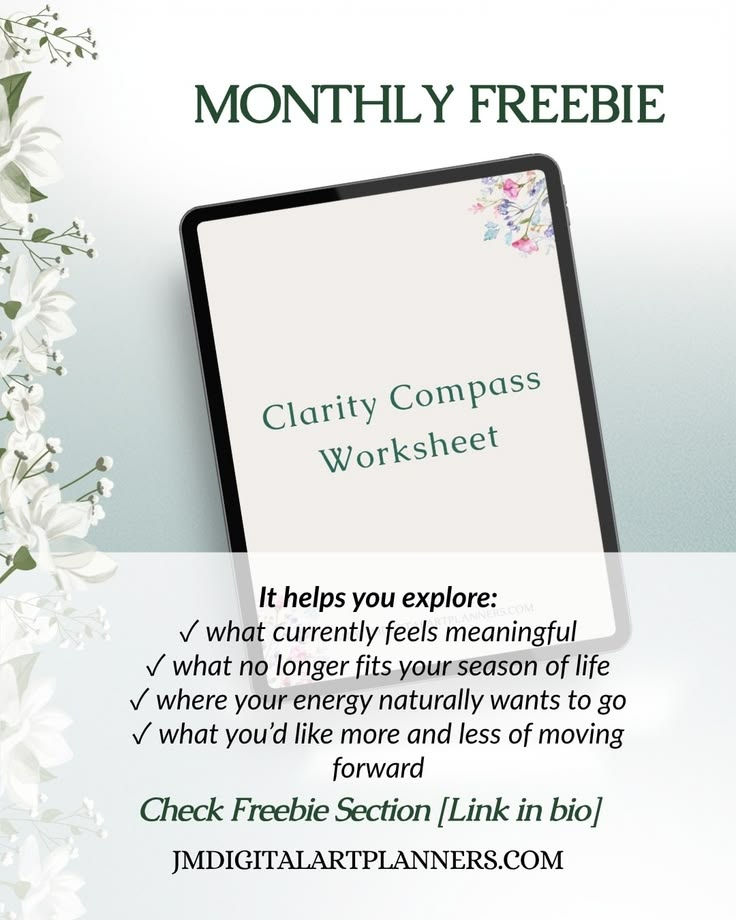
If you’re longing for a planning system that supports your emotional wellbeing instead of simply tracking tasks, you might enjoy exploring my Gentle Productivity Planners or downloading one of my free planning resources. They’re designed to help you create rhythms that feel sustainable, compassionate, and aligned with what truly matters.
When Your Compass Changes, It’s Okay
The version of you recovering from burnout may need different priorities than the version building a new career.
A new parent’s compass points in a different direction than that of someone rediscovering their creativity after years of putting everyone else first.
Your planner needs to be flexible enough to grow with you, because changing direction simply means you’ve learned something important about yourself—and that matters. It isn’t a failure; it’s just a change of course.
Growth rarely follows a perfectly straight line.
Reflection Prompts
Take a few quiet minutes with your journal or planner. Ask yourself:
Which parts of my schedule genuinely reflect what matters most to me?
Where have urgency and expectations replaced intention?
What do I want my life to feel like, not just accomplish?
What have I been protecting that no longer needs protecting?
Which relationship deserves more of my presence?
What small change would bring my calendar closer to my values?
If my planner reflected my heart instead of my pressure, what would look different?
A Different Way to Measure a Beautiful Life
A meaningful life may, of course, sometimes require taking on more tasks. Yet, more often it is built by constantly returning to what truly matters.
A planner cannot tell you what your values should be, but it can gently remind you not to lose sight of them. The primary goal of anyone’s life is hardly to become perfectly productive. However, those who seek greater happiness certainly aim to be deeply present in the moment.
Protecting what is valuable.
Simplifying what is difficult.
Nurturing what helps you grow.
A "gentle life compass" won’t spare you from every difficult decision. It won’t reduce the number of decisions you face, but it can help make each one more intentional.
And sometimes, this marks the quiet beginning of a life that finally becomes truly your own.
A Soft Life Compass won’t remove every difficult decision.
But it can help every decision feel more intentional.
And sometimes, that’s the quiet beginning of a life that finally feels like your own.

If this article resonated with you, remember that planning doesn’t have to begin with a to-do list. A conversation with yourself is also a good start.
If you’d like more gentle tools for intentional living:
explore my Gentle Productivity Planners
download one of my free planning resources
or join my newsletter for thoughtful reflections, practical planner ideas, and guided practices that support emotional clarity, nervous system regulation, and sustainable productivity. Just scroll down to the bottom of this page.
Your planner shouldn’t simply help you organise your days. It also can help you build a life that feels like home.
FAQ
What is a Soft Life Compass?
A Soft Life Compass is a gentle planning practice that helps you make decisions based on your values rather than constant urgency. Instead of organizing your life around endless to-do lists, it encourages you to regularly ask what truly matters, what you want to protect, what you can simplify, and what you want to grow. This approach supports emotional wellbeing, intentional living, and sustainable productivity by helping your daily plans reflect the life you genuinely want to create.
Why do I feel overwhelmed even when I plan everything?
Planning alone doesn’t always reduce overwhelm because overwhelm isn’t only a time-management problem. It is often a nervous system and emotional capacity issue. When your brain feels overloaded, even a perfectly organised schedule can feel impossible to follow. Gentle planning combines emotional awareness with practical organisation, helping you create plans that work with your current capacity instead of against it.
How can I figure out what truly matters in life?
One of the simplest ways is to pause before making plans and ask yourself a few reflective questions:
What matters most to me right now?
What do I want to protect?
What feels unnecessarily heavy?
What kind of life do I want my daily choices to create?
Over time, these reflections become a personal compass that guides decisions with greater clarity and confidence.
Can a digital planner help me live more intentionally?
Yes. A digital planner can become much more than a calendar or task manager. When it includes space for emotional check-ins, values-based planning, journaling, weekly resets, and gentle reflection, it helps you reconnect with your priorities before filling your schedule. Instead of simply tracking tasks, your planner becomes a supportive tool for intentional living and emotional wellbeing.
What is values-based planning?
Values-based planning means organizing your time around what is genuinely important to you rather than reacting to every urgent request or expectation. Instead of asking, “What should I accomplish today?” you begin by asking, “What kind of person do I want to be today?” This small shift often leads to healthier boundaries, more meaningful goals, and a stronger sense of purpose.
Why do I keep losing sight of my priorities?
Modern life constantly competes for your attention. Notifications, emails, deadlines, social media, and daily responsibilities all create a sense of urgency that can overshadow your personal values. Your brain naturally notices what feels urgent before what feels meaningful. Regular reflection practices, such as reviewing your Soft Life Compass each week or month, help gently bring your attention back to what truly matters.
How often should I review my Soft Life Compass?
Many people find it helpful to revisit their Soft Life Compass once a month or at the beginning of a new season. Others enjoy checking in briefly during their weekly planning session. The goal isn’t to constantly change your direction but to notice whether your current commitments still reflect your values and emotional needs.
Can my priorities change over time?
Absolutely. Your values often remain steady, but your priorities naturally evolve as your life changes. During burnout recovery, protecting your energy may become your highest priority. At another stage, creativity, relationships, learning, or personal growth may take the lead. A Soft Life Compass is designed to grow with you rather than lock you into rigid goals.
How does intentional planning support mental wellbeing?
Intentional planning helps reduce decision fatigue, creates greater emotional clarity, and encourages you to spend your energy on what matters most. By aligning your daily actions with your personal values, planning becomes a source of support rather than pressure. This often contributes to lower stress, improved emotional resilience, and a healthier relationship with productivity.
How do I start planning around what truly matters?
Start with one gentle reflection instead of a long to-do list. Before planning your week, ask yourself:
What do I want to protect this week?
What deserves more of my attention?
What can I simplify?
What would help me feel more like myself?
Then let your calendar grow from those answers. Planning becomes less about fitting more into your day and more about creating a life that feels calm, meaningful, and aligned with who you are.
I also have one suggestion that could become a defining element of your entire blog.
Almost every article you’ve written revolves around a different guiding question:
Why do I feel behind?
Why doesn’t productivity work anymore?
Did I waste my time?
What truly matters?
I think every cornerstone article could end with a small section called “A Gentle Question to Carry With You.”
For this article, it could simply be:
Before you fill your planner tomorrow, pause for one quiet moment and ask yourself:
“If my calendar reflected what truly matters to me, what would I choose differently today?”
It’s a soft ending, highly memorable, and beautifully reinforces your brand philosophy that awareness comes before action.


Interesting idea with Soft Life Compass. I'm taking this on :)
I liked the idea of planning based on values rather than urgency. It’s sort of like the Eisenhower Matrix, but it implies that “important” is what is truly valuable and matters. That’s great!
I love this article. It makes planning feel supportive. I added these 4 question to my goal planning template. Thank you for sharing
I’ve never thought of my planner as a compass before. Love this beautiful concept ❤️