Why Your Brain Creates the Feeling of Being Behind


Why Your Brain Is Designed to Notice the Feeling of Being Behind
Every adult has days when, by evening, they feel they haven't done enough, even if they’ve crossed numerous items off their to-do list and worked tirelessly. Yet, this sense of falling behind isn't always based on actual progress; it simply reflects the way the human brain is wired for survival.
Long before the advent of planners, smartphones, overflowing inboxes, and endless notifications, our ancestors lived in vastly different conditions. Survival depended on the ability to spot what was missing, uncertain, or potentially dangerous.
Is there enough food? Is the shelter secure? Was that rustling in the bushes a predator? Did we gather enough firewood before dark?
A brain that overlooked unfinished tasks or threatening situations was less likely to ensure its owner's survival.
That is why, through evolution, our brains learned to focus more on problems than on peace.
Psychologists call this tendency the "negativity effect" (or negativity bias). It is our natural inclination to notice and remember unpleasant events and to attach greater emotional weight to them than to positive ones. Researchers at the Greater Good Science Center at UC Berkeley explain that our brains prioritise potential threats over pleasant moments because, throughout evolution, paying attention to danger increased our chances of survival.
In other words, your brain isn't trying to make you unhappy; it is trying to keep you vigilant.
The problem is that modern "threats" rarely involve wild animals or life-threatening weather conditions. Instead, they look like:
unfinished projects;
unread emails;
unpaid bills;
unfolded laundry; unmet goals;
unanswered messages;
habits you are trying to build;
meetings scheduled for the coming week.
Your nervous system may subconsciously perceive these unfinished tasks as unresolved threats; consequently, you might feel like you are falling behind even when you are making significant progress.
Your brain naturally notices what remains undone before acknowledging what you have already accomplished. As a result, you become frustrated and fail to appreciate your progress, because millennia of evolution have conditioned your brain to focus on identifying things that still require protection or attention.
Understanding this helps you recognise one of the brain's most common defence mechanisms. Once you grasp why your brain behaves this way, you can respond with self-compassion rather than self-criticism.
If this idea feels familiar, you’re not imagining it. In "Why You Always Feel Behind in Life (Even When You’re Trying)", I explore why so many of us carry the constant feeling of being behind, even when we’re doing our best, and how gentle productivity can help us step out of that invisible race.

The Zeigarnik Effect: Why Unfinished Tasks Keep the Feeling of Being Behind Alive
Have you ever remembered an unfinished email while brushing your teeth? Or gone to bed only to have your brain replay the scenario for tomorrow’s important meeting and the associated to-do list? Or felt a strange sense of unease (without knowing exactly why) only to suddenly recall a task you’d forgotten to complete earlier that day?
In psychology, this is known as the Zeigarnik effect.
Named after psychologist Bluma Zeigarnik, this phenomenon describes our tendency to remember unfinished tasks more easily than completed ones.
Simply put, when something feels incomplete, the brain keeps it in an active mental state, much like a program running in a computer's working memory.
Brain keeps circling back to the task because it believes the task still requires your attention.
Imagine your brain opening a tiny mental tab every time something is left unfinished. Complete the task, and the tab usually disappears. Leave it unfinished, and the tab stays open. Now, imagine not just five tabs, but hundreds. All these "tabs" drain your emotional energy while they remain "open" in your mental operating system.
Modern life generates a staggering number of unfinished mental cycles every day. For example:
unread emails awaiting a reply
text messages you meant to answer later
notifications you planned to check
to-do list items carried over from yesterday
online shopping carts awaiting a decision
unfinished online courses
household chores
long-term goals
wellness routines
books you intend to read
ideas you promised yourself you’d start "soon"
Individually, none of these items poses a significant threat. But collectively, they quietly occupy your mental space. For your brain, there is often little distinction between "urgent" and "unfinished."
Instead, it tends to interpret anything unfinished simply as: "I haven't finished yet."
This message keeps repeating in the background of your mind, even while you are resting, having dinner, or on vacation, even if you have already accomplished dozens of important tasks.
The feeling of falling behind can linger long after the workday ends because your brain keeps highlighting those incomplete tasks. Yet, as a human being conditioned by society to constantly achieve, it is vitally important for you to acknowledge what you have already accomplished; this allows you to see progress and generate the motivation needed to keep moving forward.
If you are in the habit of breezing through your days on autopilot, your brain takes the wheel and does what evolution programmed it to do: scan for threats.
Consequently, you begin to live with the nagging feeling that you could be doing more—if only it weren't for that unfinished to-do list constantly hanging open in your mind.
This doesn't mean you have to complete every single task; that is impossible. As adults, we fully understand that balancing work, family, and children means our to-do lists will always be long. There will always be unexpected tasks we didn't plan for, as well as recurring tasks that reset—much like Cinderella’s carriage after the stroke of midnight.
However, you can consciously and intentionally create specific moments of closure for your brain.
Gentle planning techniques, such as "brain dumping," weekly reviews, and celebrating small wins, can have a surprisingly calming effect, fostering a sense of steady momentum and progress.
They provide your brain with proof that progress is happening, even when not everything is finished.
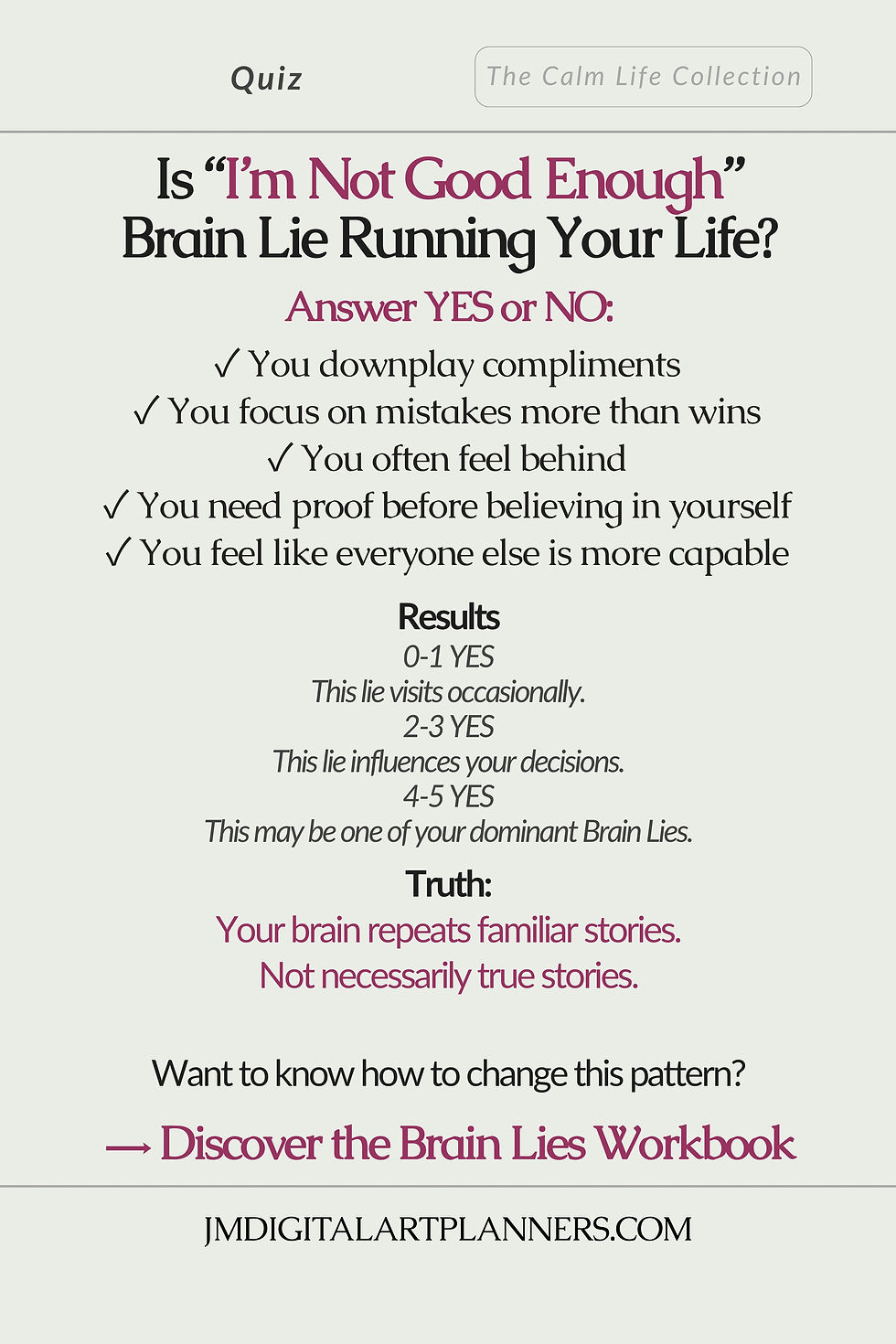
The feeling of being behind is just one example of the protective stories our brains create. The Brain Lies Workbook helps you recognise these patterns, gently question them, and replace them with supportive ways of thinking that reduce pressure instead of adding to it.
Modern Life Gives the Brain More Open Loops Than It Was Ever Designed to Carry
Our ancestors were likely preoccupied with finding food, setting up shelter, and ensuring safety at night. The challenges they faced were real, yet relatively limited in scope.
The modern human brain faces a completely different set of conditions! Let’s look at the typical morning of an average person today:
Barely having opened their eyes, they reach for their phone almost automatically. They are immediately bombarded with:
Notifications.
Messages.
Calendar reminders.
News headlines.
Work emails.
Social media.
Weather updates.
Bank alerts.
Package delivery updates.
Messages from loved ones.
To-do lists.
Bills.
Meal planning.
Fitness goals.
Meetings.
Learning new things.
Birthdays.
Maintaining friendships.
Tidying up the house.
Planning for the future.
Career management.
Self-improvement.
In just a few minutes, the brain is confronted with dozens of reminders demanding attention. Each one subtly creates yet another "open task."
Unlike the lives of previous generations, modern life rarely offers a sense of genuine completion, as so many tasks are endless:
Emails pile up again.
Laundry needs washing again.
The calendar fills up again.
Dishes need washing again.
Children need driving to classes and sports practice again.
Floors need vacuuming again.
A new project begins before the previous one feels fully finished.
A new notification arrives before you’ve even answered the last one.
As a result, for most of the day, the brain is surrounded by signals regarding unfinished tasks. No matter how skillfully or quickly you handle your tasks, your environment constantly generates these signals.
Your nervous system was not designed to hold hundreds of simultaneous reminders in memory. It evolved to respond to immediate physical challenges.
Instead, it is forced to process a ceaseless stream of digital, emotional, social, and professional obligations.
It is no wonder that the feeling of being behind and the feeling of never getting enough done have become so widespread.
For many people, this feeling does not stem from laziness, an unoptimised workflow, or poor time management. It is generated by an environment that rarely allows the brain to experience the soothing sense of completion, the feeling that enough has been done.
Why Your Brain Confuses Unfinished With Unsafe
From the brain's perspective, safety is not merely the absence of physical danger; it also about certainty, predictability, control, and a sense of closure.
For thousands of years, uncertainty often carried genuine risk: not knowing where to find food, wondering if a shelter would hold the weather, or questioning whether a rival tribe posed a threat.
Uncertainty demanded attention because survival depended on it.
Although our lives have changed drastically, the brain has not evolved at the same rapid pace. Today, for the brain, uncertainty often manifests as:
an unfinished project;
an unanswered message;
a difficult conversation;
an approaching deadline;
a financial decision;
waiting for medical test results;
the unknown of what lies ahead.
These situations rarely pose an immediate threat to our lives. We won't die from an unfinished conversation or an unanswered message. Yet, to the brain, uncertainty itself is a source of heightened threat that demands constant monitoring.
That is why unfinished tasks can feel emotionally heavier than they actually are.
The brain repeatedly returns to that "open tab" in the background, checking if you still remember the task, wondering if failing to complete it will become a problem, and constructing worst-case scenarios.
Unfortunately, endless rumination does not always lead to better decisions. More often, it escalates into:
overthinking;
intrusive thoughts (rumination);
mentally replaying conversations;
mentally planning for tomorrow;
imagining worst-case scenarios;
constantly searching for what might have been overlooked.
This ceaseless mental activity creates the illusion that staying mentally busy equals staying safe. However, there is one important nuance:
there is a vast gap between worry and awareness.
Being worry typically creates an illusion of control as the brain attempts to hold the weight of the day’s entire to-do list in its active memory.
Mindful planning based on awareness and gentle productivity teaches the brain that it no longer needs to keep every pending task constantly active in order to feel safe.
Sometimes, simply writing down a task, creating a realistic plan, or consciously deciding, "This can wait until..." is enough to gain the sense of certainty your nervous system has been seeking for so long.

The Brain Lie: “I’ll Rest When Everything Is Done”
One of the most common lies our brains tell us (something we repeat to ourselves almost daily) is: "I’ll rest once I finish my tasks."
On one hand, it feels like an act of responsibility and a way to find motivation:
Finish today’s tasks. Then you can rest.
Answer your emails. Then you can relax.
Tidy up the house. Then you can enjoy the evening.
Complete the project. Then you can finally breathe easy.
The problem is, there is no such thing as "finished." Modern life simply doesn't allow for a to-do list to ever be fully completed.
No sooner does one task disappear than another appears.
You answer five emails; three more arrive.
You complete one project; the next meeting spawns a new one.
You hit 100% of your target; next month, the target is raised by another 10%.
You clean the kitchen; half an hour later, someone decides to have a snack, and the kitchen needs cleaning all over again.
You achieve one goal; your mind immediately creates the next one.
You don't even notice the finish line constantly receding because your brain keeps redefining what "finished" means.
It whispers that there is just one more thing to do, one more task, and *then* comes the longed-for rest. Meanwhile your brain says: "Oh, look! An urgent task has popped up; it needs immediate attention, so you’ll have to relax later".
Ultimately, rest becomes a reward that is perpetually postponed. Joy turns into something that awaits you in the future. Peace becomes conditional.
You start to believe that life will only truly begin once work is over. Yet, life is passing you by while you are busy trying to get it all done.
There is a phrase I often come back to:
The brain promises peace once tasks are finished, yet it keeps creating new definitions of what counts as "finished."
That is why so many high achievers feel exhausted. They aren't chasing the final task; they are chasing a feeling that endless productivity simply cannot provide: the sense that your worth does not depend on the volume of work you have completed.
Gentle productivity offers a different path.
Instead of postponing rest until everything is finished, it invites us to feel that we have "done enough" right in the midst of the journey. After all, the ultimate form of productivity is not some mythical point where no tasks remain.
It is about building a life where your nervous system knows that your worth is not tied to completing a to-do list that never ends.
What Actually Helps the Brain Feel Safe
If your brain makes you think that you’re feeling behind by constantly fixating on unfinished business, trying to "work harder" may only lead to overwhelm.
"Gentle productivity" signals to the brain that it does not need to remain in a state of high alert. Its primary goal is to help the nervous system feel safe, allowing attention to shift away from the constant scanning for threats and toward something else.
Instead of the usual question "How to cram more tasks into the day" gentle productivity suggests asking: "How can I reduce the mental load my brain carries trying to remember, anticipate, and control everything?"
Many useful gentle productivity practices for a planner work because they reduce uncertainty, "close" unfinished mental loops, and reassure the brain that nothing important will vanish if you let go of control. They can be:
Closing loops intentionally
The brain dislikes unfinished business. Remember all those "open tabs" in your mind? Whenever possible, finish tiny tasks completely rather than leaving dozens of things half-done.
Even simple actions, such as replying to a single email, putting away clean laundry, or checking off a task in your planner, give the brain a sense of closure.
These small moments of completion add up to a feeling of emotional relief.
Brain dumps
As long as thoughts remain in your head, your brain keeps "looping" them to ensure they aren't forgotten. Writing everything down shifts that responsibility to an external medium.
Research on expressive writing has shown that putting thoughts into words reduces mental load and improves the emotional processing of experiences. Work by psychologist James Pennebaker demonstrates that expressive writing fosters well-being by helping to organize complex thoughts and life experiences. Instead of keeping dozens of reminders in your working memory, you turn your planner into a reliable external system.
Your brain no longer needs to remember everything, because it knows there is a secure place to store every thought.

Weekly planner reviews
Reviewing your week creates another kind of closure.
Instead of seeing isolated unfinished tasks, you begin to notice completed projects, important conversations, acts of courage, and small victories that might otherwise have been lost amidst tomorrow's obligations.
This shifts your attention from “everything left to do” toward “everything already moving forward.”
Realistic expectations
The feeling of being behind often arises because we compare ourselves to an idealised version of ourselves, someone who always has it all together and possesses boundless energy and time. Yet, reality is often different. Our capabilities, energy levels, our lives, and we ourselves change day by day.
A compassionate planning system allows your expectations to change alongside them.
There are days when your "maximum" output looks like the "minimum" output of a day when you were full of energy. We tend to berate ourselves for this inconsistency, but it is simply a part of human nature.
Celebrating completion
Because the brain is wired to focus on the negative, we naturally remember problems better than successes.
This means that progress often goes unnoticed unless we make a conscious effort to acknowledge it.
Creating a "joy jar" or recording even the smallest victories trains your attention to spot signs of progress, rather than just focusing on what remains undone.

Emotional check-ins
Sometimes, the reason a task feels impossible has nothing to do with the task itself.
Your emotional state is a resource for getting things done, just like money or help from others. And this resource cannot remain stable, because you are a human being, not a robot.
Checking in with your emotional state before planning helps you respond to what you actually need instead of forcing yourself through invisible resistance.
Reducing decision fatigue
Every decision consumes mental energy.
Research by psychologist Roy Baumeister and his colleagues shows that the need to constantly make decisions leads to mental fatigue, making subsequent choices more difficult.
Simple planning systems reduce the number of unnecessary decisions. They can be:
Weekly meal plans (check the weekly meal plan printable template here).
Morning rituals (you can dive deep in this topic by reading my blog post on how to create a morning routine that sets the tone for a joyful day or read more about morning routine for energy alignment)
Standard work time blocks.
The fewer decisions your brain has to make, the more energy remains for meaningful work.
Capacity planning
Traditional planners often assume that we start every day with a full tank of energy. In real life, that isn't the case.
Capacity planning asks, “Given my current energy, what feels realistic today?”
Instead of planning based on an idealised version of yourself, you start from reality. Paradoxically, this often leads to greater stability, since plans become achievable rather than merely desirable.
Many traditional planning methods assume you always have the same emotional capacity. "Why Productivity Systems Stop Working When You’re Overwhelmed" explores why productivity systems often fail during overwhelm and how planning can become a source of regulation rather than pressure.
Gentle Planner Practice: “Evidence That I’m Moving Forward” When I Feel Behind
Daily planning templates in most planners typically begin with a to-do list. While planning tasks is both useful and important, this ritual inadvertently trains your brain to focus on things that haven't happened yet.
Your attention instantly shifts to what is missing or unfinished. This creates a sense of rushing right from the start of the day, after all, there is so much to do and so little time. It feels like a race for progress.
Mindful productivity teaches you to notice progress, allowing you to gather evidence that you are moving forward and achieving your goals.
Try starting your morning with a page titled "Evidence That I Am Moving Forward."
Before addressing what needs to be done today, ask yourself: "What evidence already exists that my life is moving forward?"
You can also practice this in the evening. Consistency is key. Dedicate just a few minutes to these simple exercises:
Evidence That I’m Moving Forward
Today I completed… (even if it was something small. Finished doesn’t have to mean impressive)
Today I noticed… (A beautiful flower. A calmer morning. A helpful conversation. The warmth of sunlight on your desk). Awareness is progress, too
Today I learned… (A healthier boundary. A kinder response to yourself)
Today I rested… (rest is one of the reasons progress becomes sustainable. Notice every moment your body recovered)
Today I protected… (peace, energy, boundaries, values). These quiet decisions deserve recognition.
Today I released… (A perfectionistic expectation. A guilty thought. An unrealistic deadline. A comparison). Letting go is also movement.
Today I’m proud of… (Not because it was perfect, but you showed up, continued, cared).
Over time, these pages become a beautiful archive of evidence that your brain simply forgot to notice.
If you’re learning to notice progress instead of pressure, you may also enjoy Monthly Reset Ritual: Gentle Planning for Balance and Creating a Reset Ritual with Your Planner to Overcome Burnout. Together, these gentle practices help you reflect on what truly matters, close mental loops, and begin each new week or month with greater clarity instead of urgency.

Reflection Questions When You Feel Behind
Reflection creates a pause between automatic thoughts and conscious awareness. Many of the beliefs that make us feel behind operate quietly in the background. We rarely question them because they feel true.
These questions invite you to slow down and gently investigate the story your brain is telling.
There are no right or wrong answers.
Take a few quiet minutes with your journal or planner and explore:
Which unfinished task occupies the most space in my mind?
Notice whether it’s truly the largest task or simply the one your brain has attached the most emotion to. Sometimes the loudest task isn’t the most important one.
Is it truly urgent, or simply unfinished?
Our brains often confuse unfinished with urgent. Ask yourself whether this task genuinely requires attention today or whether it simply feels uncomfortable to leave open.
What does my brain believe will happen if I don’t finish it today?
This question often uncovers hidden fears. Maybe your brain says:
“I’ll disappoint people.”
“I’ll lose momentum.”
“I’ll never finish.”
“People will think I’m lazy.”
Once these fears become visible, they become easier to examine with compassion.
Which thoughts are facts?
Separate observable reality from emotional interpretation. Facts might sound like: “The report is due Friday" or “I completed three tasks today.”
Interpretations might sound like: “I’m failing.” “I’m so far behind.”
Recognising the difference creates emotional clarity.
Which thoughts are protection patterns?
Many anxious thoughts are attempts to keep you safe. Your brain may believe that worrying constantly will prevent mistakes. Thank it for trying to help, then gently remind yourself that constant pressure isn’t the only path to responsibility.
What evidence already exists that I’m moving forward?
List every small piece of evidence you can find (a conversation, a boundary, a finished email, a healthy meal, a walk, a deep breath before reacting).
Tiny evidence changes big stories and often teach your brain to see your life more accurately.
Feeling behind and constantly trying to catch up often come from the same underlying pattern. "Why You’re Always Trying to Catch Up (And How to Stop)" explores why the brain becomes trapped in chronic urgency and how gentle productivity helps you replace endless catching up with a more peaceful rhythm of living.
A Different Way to Think About the Feeling of Being Behind (New Definition of Progress)
I want to articulate the key idea of this article:
your life shouldn't be something that is ever truly "finished." There will always be another email, another goal, a room to tidy, a dream to pursue, a duty to fulfil, a conversation to have, or a task to complete. If your definition of progress boils down to reaching the end of your to-do list, you risk spending your entire life waiting for a finish line that keeps moving further away.
Perhaps progress isn't about finishing everything at all, but rather trusting yourself and having the confidence that you will continue the journey tomorrow.
Perhaps it is the ability to notice beauty even when your to-do list is far from "done" and the willingness to care for your own energy instead of trying to prove your worth.
Progress is the rest you allow yourself before total exhaustion sets in.
It is that moment at the end of the day when you close your planner and think, with genuine kindness toward yourself, "I did enough today. I did a great job" even if there are still unfinished tasks.
After all, true productivity isn't measured by how empty your task list is, but by whether your planning helps you build a life you truly want to live.
Life wasn't meant to be a list of chores to be rushed through and completed. It was given to you to be lived—moment by moment, day by day—with care, imperfection, and joy. It is a state of ongoing unfolding, where something else awaits you just around the bend.
If this article helped you understand why the feeling of being behind appears so often, know that awareness is only the beginning. Small, supportive practices can gradually help you build a calmer relationship with planning, productivity, and yourself.
If you’d like a little more guidance, here are a few resources that may support your next step:
Explore the Gentle Productivity Planners: My digital planners are designed to support emotional wellbeing alongside intentional planning. You’ll find gentle planning systems, emotional check-ins, weekly resets, capacity planning, reflection pages, and tools that help you work with your nervous system instead of against it.
Download Free Resources: If you’re just getting started, explore my collection of free planning templates, journaling pages, reset worksheets, and self-care resources. They’re designed to help you create more clarity with less pressure, one small step at a time.
Join the Newsletter (scroll to the bottom of this page): I share gentle reflections, practical planning ideas, emotional wellbeing tools, and exclusive resources to help you build sustainable productivity without burnout. Think of it as a quiet corner of the internet where planning feels supportive, not stressful.
Frequently Asked Questions About the Feeling of Being Behind
Why do I always have the feeling of being behind?
Your brain naturally pays more attention to what still needs attention than to what you’ve already accomplished. Psychologists call this negativity bias, a survival mechanism that evolved to help humans notice potential threats more quickly than signs of safety. While this once helped our ancestors survive, today’s world presents our brains with an endless stream of unfinished tasks, notifications, emails, goals, and responsibilities.
As a result, you may complete dozens of meaningful things in a week but still feel as though you’re falling behind because your attention keeps returning to what remains unfinished.
The feeling can become even stronger if you’re experiencing stress, burnout, perfectionism, or emotional fatigue, because these states make the brain even more sensitive to uncertainty.
Recognizing this pattern is often the first step toward reducing its influence. Try asking, “What evidence already exists that I’m making progress?”
The feeling of being behind isn’t always a reflection of reality. Often, it’s the result of how your brain processes unfinished tasks, uncertainty, and perceived responsibilities.
Is the feeling of being behind normal?
Yes. In today’s fast-paced, digitally connected world, it’s incredibly common.
Most people are managing far more information than the human brain evolved to process. Between work responsibilities, family life, social media, personal goals, finances, health, and constant digital notifications, there is almost always something left unfinished.
This creates what psychologists sometimes describe as open loops. These unfinished tasks remain mentally active and continue drawing your attention, even when you’re trying to relax.
Feeling behind doesn’t necessarily mean you’re failing.
Often, it means your brain is doing exactly what it was designed to do: scanning for incomplete tasks and potential problems.
The goal isn’t to eliminate every unfinished task. That’s impossible.
Instead, gentle productivity helps you develop a healthier relationship with unfinished work by creating systems that support both emotional wellbeing and sustainable progress.
Why does the feeling of being behind get worse during burnout?
Burnout changes how the brain processes effort, decision-making, and stress.
When your nervous system has been under prolonged pressure, everyday tasks require more mental energy than they normally would. Activities that once felt simple may suddenly feel overwhelming.
At the same time, responsibilities usually don’t decrease. The to-do list stays just as long while your available energy becomes much smaller.
This creates a painful mismatch between expectations and capacity.
The brain notices everything that isn’t getting done and interprets it as evidence that you’re falling further behind, even though your reduced productivity is a natural response to chronic stress rather than a personal failure.
Research on stress and burnout has shown that prolonged stress affects attention, memory, emotional regulation, and executive functioning, making planning, prioritizing, and initiating tasks more difficult.
This is why burnout recovery isn’t simply about becoming more disciplined.
It’s about helping your nervous system regain a sense of safety before expecting consistent productivity.
How can I reduce the feeling of being behind?
The feeling of being behind usually doesn’t disappear by working harder. Instead, it often softens when you change what your brain pays attention to.
Some gentle practices that can help include:
doing a brain dump to move mental clutter onto paper
closing one small open loop instead of trying to finish everything
keeping a Joy Bank where you record daily wins and moments of progress
reviewing what you’ve completed before planning what comes next
practicing emotional check-ins before creating a to-do list
adjusting your plans to match your current energy and capacity
celebrating consistency instead of perfection
limiting unnecessary sources of digital input and decision fatigue
These practices gently teach the brain that progress is happening, even when everything isn’t finished.
Over time, this helps replace chronic urgency with a greater sense of clarity and self-trust.
Can planning reduce the feeling of being behind?
Yes, but only if planning supports your wellbeing rather than increasing pressure.
Traditional planning systems often focus only on productivity: more goals, more tasks, more optimization.
Gentle planning begins somewhere different.
It asks:
How do I feel today?
What is realistic with the energy I have?
What would help me feel supported?
What is one meaningful next step?
When planning includes emotional awareness alongside practical organization, it becomes a way to reduce decision fatigue, create emotional safety, and remind your brain that progress isn’t measured only by what’s left to do.
A planner can’t eliminate every responsibility, but can help you experience those responsibilities with more clarity, more compassion, and far less overwhelm.
The goal isn’t to finish everything, but to build a life where you no longer feel like you’re constantly trying to catch up.


The idea that my to-do list and the life itself were not ever meant to be completed just knocked me down.. this is the one of the most powerful insights of my life. I mean it. I had this feeling of race to have an empty to-do list (not that one that you do for every day, but that a real one, long enough for your whole life) and now I understand that it’s impossible.
Another thoughtful article. Your gentle productivity approach feels like a breath of fresh air compared to traditional productivity advice.
The planner prompts at the end are beautiful. I’ll definitely be adding them to my journal.
I love how you combine psychology with gentle planning. It feels so compassionate 🥹