Your Planner Should Measure Progress, Not Self-Worth
- Julia Maslava

- 8 hours ago
- 11 min read

Why does my planner make me feel guilty?
Short answer:
Many people unknowingly use their planner to measure their value instead of supporting their wellbeing. When unfinished tasks become proof that we’re “not doing enough,” planning creates pressure. Gentle productivity helps transform your planner into a tool for self-trust, emotional awareness, sustainable progress, making it easier to move forward without burnout.
Your Planner Was Never Meant to Judge You
I used to think planners had a simple purpose: write down tasks, complete them, and repeat tomorrow.
The system seemed straightforward. Yet, on some days, opening my planner brought an immediate sense of relief. On other days, opening that same planner made me feel as though I had failed before the day had even begun.
An unfinished to-do list can quietly become evidence that you are falling behind. Skipping a habit feels like proof of a lack of discipline. That wretched "done" checkbox, left blank, seems to whisper that you aren't trying hard enough.
Over time, the planner loses its simple essence—tasks, completion, repetition. It begins to act as a silent report card, a reminder that we aren't doing enough, since the to-do list never truly ends.
I am reminded of the character in the movie *Kate & Leopold* who said she disliked Sundays because they were poisoned by the looming presence of Monday. In the same way, a planner becomes poisoned by our "failures" and "weaknesses."
But the issue isn't the planners themselves; they have nothing to do with it. We simply burdened them with a role they were never meant to play.
A planner cannot measure your kindness or record how hard it was to get out of bed after a exhausting week. It cannot see the invisible emotional labor, the healing, the grief, the recovery or the periods of disappointment followed by the internal struggle just to keep living.
And yet, we turn to it to judge whether we were "good enough" today.
No planning system can answer that question when it comes to our inherent worth. And yet, with remarkable stubbornness, we evaluate ourselves based on the number of items crossed off our to-do lists.
When Planning Becomes Self-Evaluation
Planning often begins as a practical habit. We want to organise meetings, cultivate new habits, capture ideas, improve time management, set aside time for what truly matters.
However, somewhere along the way, many of us stop tracking our plans and start tracking our own self-worth; an unchecked box becomes a personal failure, while a productive day becomes a source of pride. And if we have a quiet day, we feel guilty for not being active enough!
You might recognise this pattern if you have ever:
felt guilty after moving the same task to tomorrow
avoided opening your planner because it felt overwhelming
judged yourself after missing a habit streak
believed a productive day made you a “better” version of yourself
felt anxious looking at unfinished weekly goals
The emotional burden stems not from the planner itself, but from the meaning we attach to it. Instead of becoming a supportive companion, the planner begins to reflect all our fears about our own inadequacy.
This is often the first step toward recognising another brain protection pattern.
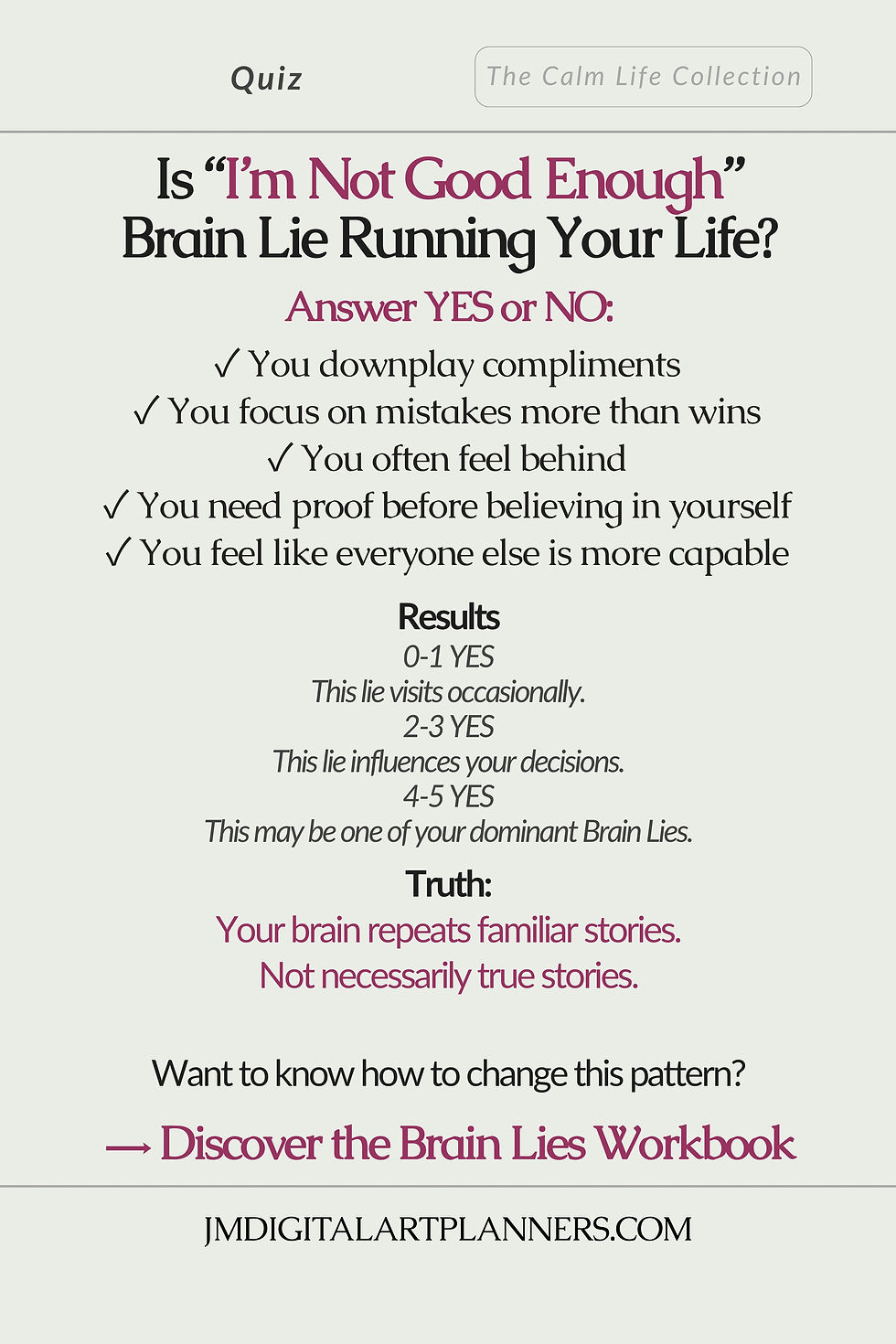
Why Your Brain Looks for Evidence About Your Self-Worth in a Planner
Our brain is an amazing mechanism capable of finding patterns. Every day, it gathers thousands of bits of information and attempts to weave them into a coherent story.
This ability helped our ancestors survive.
The capacity to recognise patterns in the world around us made it easier to anticipate danger, learn from experience, and avoid future threats.
This process continues today.
However, instead of scanning the forest for predators, our brain now often looks for confirmation of specific beliefs about ourselves in our daily lives.
If, deep down, we start to believe that we aren't productive enough, lack discipline, or are falling behind in some way, our brain sets out to find information that confirms these fears.
Psychologists call this tendency "confirmation bias." Once a belief is formed, we naturally notice evidence that supports it while overlooking facts that contradict it. This doesn't happen because we are irrational; it is simply one of the ways the brain simplifies our perception of a complex world. The American Psychological Association offers educational materials explaining how cognitive biases influence perception and decision-making.
Imagine two scenarios.
Today, you completed eight important tasks. One task remained unfinished. Which one will you remember when you are lying in bed, trying to fall asleep?
Many people remember the unfinished task.Not because it is more important than the others, but because it seems to confirm a pre-existing self-image: "See? You didn't do everything you planned again. You'll have to catch up tomorrow."
Your planner turns into a file of evidence where the crossed-off tasks fade into the background, and the unfinished item becomes the day's main event. Kristin Neff’s research consistently shows that people who practice self-compassion respond to setbacks with greater resilience, maintain healthy motivation, and engage in less harsh self-criticism. Instead of viewing mistakes as proof of personal inadequacy, they see them as a natural part of the human experience.
Similarly, Brené Brown draws a distinction between guilt and shame. Guilt says, "I made a mistake." Shame whispers, "I am a mistake." That changes everything.
When planners become a tool that fuels shame, they cease to foster personal growth.
If, however, you turn your planner into a tool for mindfulness, it can help you rebuild trust in yourself.
The same brain patterns that make your planner feel like a report card can also create the persistent feeling that you’re falling behind, even when you’re making real progress. In Why Your Brain Creates the Feeling of Being Behind, we explore why unfinished tasks stay in your mind and how gentle planning helps retrain your attention toward what truly matters.

The Hidden Question Behind Every To-Do List
A classic to-do list asks what needs to be done today. If your list is an endless stream of new tasks arriving at a rate of "one done, two added," sooner or later your brain will start asking an unspoken question in the background: will you finally feel "good enough" once you finish everything on that list? And, more importantly, when?
This question carries impossible expectations because a list completed today simply becomes a new beginning tomorrow, much like laundry or cooking, chores that never truly end and serve as a silent, stern reminder that dirty clothes rise from the ashes like a phoenix, time and time again.
Another meeting, another project to start, another room to clean, another deadline, and the finish line once again looms somewhere on the horizon.
Many people fail to realise that they are chasing a feeling of being "finally enough," not merely a completed to-do list. Rest is first postponed, then transformed into a magical carrot we promise to eat only after everything is done. Eventually, we simply stop allowing ourselves to rest at all, viewing it as an unaffordable luxury.
It is no wonder so many people describe a constant feeling of falling behind. The finish line was never a physical destination; it was a feeling they hoped would come with achievement.
If you constantly feel as though you’re chasing an invisible finish line, you’re not alone. Why You’re Always Trying to Catch Up (And How to Stop) explains why catch-up mode is often a nervous system state rather than a time management problem, and how to step out of the cycle with greater compassion and clarity.

Progress and Worth Are Different Things
Unfortunately, we often confuse progress with our own worth.
A slow-paced week does not diminish your value. A difficult phase in life does not erase your capacity for creativity. An unfinished project does not make you any less intelligent. Rest does not weaken your ambitions. Taking time to recharge does not negate your potential.
These truths can be surprisingly hard to believe, given that many of us have spent years being praised primarily for our achievements rather than for who we are. Over time, it begins to feel as though achievements are the price one must pay to be accepted.
The concept of "gentle productivity" offers a different perspective:
Your worth is not something that must be earned through constant effort. It is something you bring to every action you take. It is you. You are your worth.
Planning cannot create your worth; instead, it helps you care for a life that is already valuable in itself.
What Gentle Productivity Measures Instead
If we compare traditional productivity systems with gentle productivity, the former measure visible results, whereas mindful productivity focuses on your experience, something that often goes unnoticed.
It asks questions such as:
Did I honour my capacity today?
Did I notice when I needed rest?
Did I keep a promise to myself, even a tiny one?
Did I move one step closer to something meaningful?
Did I celebrate any progress?
Did I recover after a difficult moment?
Did I show myself compassion?
Inside gentle planning method, this often includes:
emotional check-ins before planning
capacity planning instead of unrealistic scheduling
a Joy Bank for collecting small wins
minimum versions for low-energy days
weekly reset rituals focused on awareness
reflection pages that highlight growth rather than perfection
These practices help make your ambitions and the planning for their realisation sustainable.
If you’re beginning to rethink your relationship with planning, you might enjoy exploring my gentle productivity planners or downloading one of the free planning resources designed to support emotional clarity before productivity to change the way planning feels.

Gentle Planner Practice: “Evidence of Who I Became Today”
Here is a page, that you can create in your planner. It's not about accomplishments at all. "Evidence of Who I Became Today" can help you to nourish self-worth from experiencing your life.
Complete these gentle prompts:
Today I showed courage by…
Today I trusted myself when…
Today I kept a promise to myself by…
Today I protected my energy by…
Today I learned…
Today I noticed…
Today I treated myself kindly when…
One quiet achievement nobody else saw…
One moment that reminded me I’m growing…
This self-worth planner page shifts your attention from performance to identity.
It doesn't ask you how much you did. It highlights who you are becoming.
Day by day you collect the evidences that you're learning, adapting, recovering, and the most important, evidence that you can trust yourself again.
Questions to Ask Before You Judge Your Day
Before deciding whether today was successful or not, pause for a moment.
Ask yourself:
If someone I loved had this exact day, what would I say to them?
Can I offer myself the same compassion?
What required more energy today than anyone else could see?
Did I respect my capacity?
Which unfinished task can wait without harming what truly matters?
What did I protect today?
What evidence already exists that I’m growing?
Sometimes these questions reveal far more progress than any completed checklist ever could.
Your Planner Was Always Meant to Build Self-Trust
This is perhaps the greatest misconception about planning.
A planner cannot measure your worth; it cannot gauge your courage or quantify the healing process. It won’t record every heavy thought you overcame before even getting out of bed. It won’t see the unseen effort required to build healthier habits, set boundaries, or choose rest before reaching total exhaustion.
Such moments rarely fit into the neat boxes of a schedule.
And yet, they shape our lives far more profoundly than perfectly executed to-do lists.
Perhaps the true purpose of your planner is to serve as a gentle space, a reminder of the path you’ve traveled, the lessons you’ve learned, and the person you are becoming.
Every decision made with self-compassion. Every boundary upheld. Every small promise kept. Every attempt to gently start anew. Together, these things take on immense value and stand as proof that you can trust yourself.
And self-trust often provides the quiet foundation that makes genuine, sustainable productivity possible.
Learning to trust yourself again rarely happens through bigger goals or stricter routines. It grows through small, consistent experiences of keeping gentle promises to yourself. If you’d like to explore that journey more deeply, From Self-Doubt to Self-Trust: A Gentle Path Forward offers practical reflections and supportive planner practices to help you replace self-criticism with quiet confidence.
If you’d like more gentle planning practices like these, explore my collection of gentle productivity planners, download one of my free planning resources, or subscribe to newsletter for thoughtful reflections, practical planner ideas, and emotionally supportive routines.
Every resource is designed to help you create a calmer relationship with productivity, one compassionate page at a time.
Frequently Asked Questions
Why does my planner make me feel guilty?
Many people unknowingly begin using their planner as a measure of their worth instead of a tool for support. An unfinished to-do list can start to feel like evidence that they’re failing, even when they’ve accomplished meaningful things. Gentle productivity encourages a different perspective. Your planner isn’t there to judge you. It’s there to help you organize your life with greater awareness, compassion, and emotional clarity.
Can a planner improve self-worth?
A planner cannot create your self-worth because your worth isn’t something that needs to be earned. What a planner can do is help strengthen self-trust by giving you space to recognize your progress, honour your capacity, celebrate small wins, and reflect on what truly matters. Over time, these small moments become evidence that you can rely on yourself with kindness instead of criticism.
How can I stop using my planner as a report card?
The first step is noticing the pattern without judging yourself. If you only look for unfinished tasks, your brain will naturally overlook everything that went well. Try adding reflection pages that highlight what you completed, what you learned, how you cared for yourself, and how you adapted to unexpected challenges. A planner should document your life, not determine your value.
Why do unfinished tasks make me feel like I’m failing?
Our brains naturally pay more attention to unfinished work than completed work. This tendency is connected to the Zeigarnik Effect, which explains why incomplete tasks remain active in our minds, and to negativity bias, which causes the brain to notice potential problems more readily than positive experiences. Together, these patterns can create the feeling that you’re always behind, even when you’re making steady progress.
How can I build self-trust through planning?
Self-trust grows through small, consistent experiences rather than perfect performance. Every time you choose a realistic next step, respect your energy, keep a small promise to yourself, or gently begin again after a difficult day, you’re strengthening your confidence in yourself. A planner becomes most supportive when it helps you notice these moments instead of focusing only on completed checklists.
What should I track instead of just completed tasks?
A gentle productivity planner can track many forms of progress that traditional planners often overlook. For example, you might record:
emotional check-ins
small wins
moments of courage
acts of self-care
boundaries you respected
lessons you learned
things that restored your energy
ways you adapted to challenges
meaningful conversations
moments of gratitude
These reflections help train your brain to recognise growth beyond visible productivity.
Can gentle productivity help reduce burnout?
Yes. Gentle productivity is designed to support sustainable progress by working with your current capacity instead of constantly pushing beyond it. When planning includes emotional awareness, nervous system regulation, realistic expectations, and regular rest, it becomes easier to move forward without creating additional pressure. This approach helps reduce the cycle of overwhelm that often contributes to burnout.
What is the difference between productivity and gentle productivity?
Traditional productivity often focuses on maximising output, completing more tasks, and improving efficiency. Gentle productivity begins somewhere else. It starts by asking how you’re feeling, what your current capacity is, and what feels manageable today. Rather than measuring success by how much you accomplish, it values consistency, self-trust, emotional wellbeing, and sustainable progress over time.
Can a digital planner support emotional wellbeing?
Yes. A thoughtfully designed digital planner can become more than an organizational tool. When it includes emotional check-ins, reflection prompts, capacity planning, gratitude pages, and gentle planning practices, it can help you become more aware of your needs, reduce decision fatigue, and build healthier daily rhythms. While a planner isn’t a replacement for mental health care, it can be a valuable companion for creating more intentional and balanced routines.
What is the most important thing to remember when planning?
Remember that your planner is there to support your life, not to evaluate it.
Your worth isn’t determined by the number of boxes you checked today.
Some of the most meaningful progress will never appear on a to-do list.
The conversations that healed you.
The boundaries that protected your peace.
The rest that restored your energy.
The courage it took to begin again.
Those moments matter just as much as anything you accomplished.
Perhaps even more.


The idea that a planner should build self-trust really stayed with me. Beautifully written 🙏